


Types of Paints for Art: An Expert Guide For Understanding Art Colors

Ever stood in an art supply store, completely overwhelmed by the sheer number of tubes and bottles, wondering which Types of Paints for Art are right for you? It’s like a candy store for creatives, but with a slight hint of “where do I even begin?” Choosing the right medium is like picking the perfect voice for your story – each one has its own personality, its own strengths, and its own unique way of speaking.
Understanding the different Types of Paints for Art isn’t just about knowing their names; it’s about getting a feel for how they behave, how they blend, and what kind of magic they can create on your canvas. Let’s dive into the vibrant world of art colors and uncover what makes each type special.
Water-Based Wonders: Exploring Watercolor and Gouache
When we talk about water-based Types of Paints for Art, two stars immediately come to mind: watercolor and gouache. While both rely on water for thinning and cleanup, their personalities are strikingly different, offering artists distinct avenues for expression.
Watercolor: The Dance of Transparency and Light
Ah, watercolor! It’s famously elusive, often described as a medium that “paints itself.” Known for its luminous transparency, watercolor allows light to bounce off the white paper beneath, creating a glow that’s truly captivating. It’s all about building layers, letting each wash dry before adding another, creating depth and subtle color shifts.
The magic of watercolor lies in its ability to capture delicate atmospheric effects, soft transitions, and a sense of spontaneity. It’s often the go-to for landscape sketches, floral studies, or any piece where a light, ethereal quality is desired. Mastering the flow of these Types of Paints for Art can take a lifetime, but the journey is endlessly rewarding.
Gouache: Opaque Vibrancy with a Matte Finish
Now, if watercolor is the shy, transparent cousin, gouache is its bolder, opaque sibling. While also water-soluble, gouache contains a higher pigment load and usually a chalk additive, which gives it a velvety, matte finish. Think of it as watercolor’s more robust counterpart, capable of producing rich, solid areas of color.
Gouache is fantastic for illustrations where flat, even tones are needed, or for adding crisp details over watercolor washes. It’s versatile too; you can thin it down for translucent effects or use it thickly for vibrant, opaque statements. These Types of Paints for Art offer a wonderful balance of control and expressive potential, a true delight for designers and artists alike.
The Versatility of Acrylics: Modern Art’s Favorite Medium
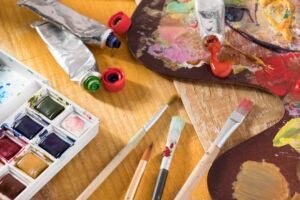
Acrylics burst onto the art scene in the mid-20th century and quickly became a darling of contemporary artists. Why? Because they’re incredibly versatile, fast-drying, and forgiving. If you’re looking for Types of Paints for Art that can do almost anything, acrylics are your champion.
Fast-Drying Freedom: Building Layers with Acrylic Paint
One of the biggest advantages of acrylic paint is how quickly it dries. This means you can layer colors without muddying them, experiment with textures, and complete pieces in a much shorter timeframe than with oils. It’s fantastic for artists who like to work quickly or those who are impatient to see their vision come to life.
Acrylics can be thinned with water to mimic watercolors, used thickly like oils for impasto effects, or even mixed with various mediums to change their consistency, drying time, or sheen. This adaptability makes them perfect for experimental work, mixed media projects, and bold, modern art paintings.
Blending and Texture: Achieving Diverse Effects with Acrylics
The plastic-like binder in acrylics offers incredible opportunities for texture. You can create smooth, flat surfaces or build up thick, sculptural passages that stand proud from the canvas. This ability to manipulate texture is why many contemporary artists choose these Types of Paints for Art for their expressive power.
You can blend acrylics seamlessly for soft gradients or use them for sharp, crisp edges. They adhere to almost any surface – canvas, wood, paper, fabric, even glass – making them an incredibly practical choice for a wide range of artistic endeavors, from fine art to craft projects.
The Enduring Allure of Oil Paints: A Timeless Classic
For centuries, oil paint has been the cornerstone of fine art, beloved by masters for its rich colors, exceptional blendability, and luminous depth. While it demands patience, the results achieved with oil paints are often unparalleled, creating works that truly sing with life. These Types of Paints for Art have a storied history for a reason.
The Slow Dance of Oils: Unlocking Richness and Depth
The defining characteristic of oil paint is its slow drying time. While this might sound like a drawback, it’s actually its greatest strength. It allows artists ample time to blend colors directly on the canvas, creating smooth transitions, subtle shifts in tone, and an incredible sense of realism. Think of the soft glow in classical portraits or the atmospheric depth in old master landscape paintings.
This extended working time means you can manipulate the paint for hours, moving it around, adding glazes, and building up layers with remarkable precision. It’s a meditative process, a slow dance with color and light, where every stroke contributes to a profound sense of presence and materiality.
Glazing and Impasto: Mastering Traditional Oil Painting Techniques
With oil paint, you can achieve stunning effects like glazing, where thin, transparent layers of color are built up to create deep, jewel-like tones and incredible luminosity. This technique adds an optical depth that’s unique to oils, making colors appear to glow from within. It’s a truly magical aspect of these Types of Paints for Art.
Conversely, oil paint also excels at impasto, where paint is applied thickly, creating visible brushstrokes and a tactile surface. Think of Van Gogh’s swirling skies or Rembrandt’s textured fabrics. These techniques add expressive power and a physical dimension to the painting, inviting the viewer to feel the surface as much as to see it.
Beyond the Big Three: Exploring Lesser-Known Pigments
While watercolor, acrylic, and oil are the undisputed titans of the art world, there’s a whole universe of other fascinating Types of Paints for Art waiting to be discovered. Each offers a unique texture, finish, and working experience.
Encaustic Paint: Ancient Wax and Pigment Magic
Have you ever heard of encaustic paint? It’s an ancient medium that uses heated beeswax mixed with colored pigments. The molten wax is applied to a rigid surface, and once cooled, it forms a durable, luminous, and often textured surface. It’s a sensuous, sculptural medium that has seen a resurgence in contemporary art.
Working with encaustic is a tactile experience, involving heat, scraping, and fusing layers. The resulting surfaces can be translucent or opaque, smooth or highly textured, and have a unique, almost gem-like quality. It’s a fascinating choice for those who love to experiment with different Types of Paints for Art and create truly dimensional works.
Tempera Paint: The Rich History of Egg-Based Mediums
Before oils became dominant, tempera paint, particularly egg tempera, was the go-to medium for centuries, especially for panel paintings and icon art. It’s made by mixing powdered pigments with an egg yolk binder, creating a fast-drying, durable, and remarkably luminous paint.
Egg tempera dries to a beautiful, velvety matte finish and is known for its incredible detail and precision. It’s applied in thin, careful strokes, building up subtle gradations of color and light. While challenging, mastering this classic medium offers a unique connection to art history and a distinct aesthetic that differs from other Types of Paints for Art.
The Call of the Canvas: Choosing Your Artistic Voice
Ultimately, the best Types of Paints for Art for you depends on your personal style, your patience, and the kind of visual story you want to tell. Do you love the spontaneous fluidity of watercolor for delicate seascapes? Or the bold, immediate impact of acrylics for vibrant sports scenes? Perhaps the luxurious blendability of oils for classic trees and portraits calls to you?
There’s no single “correct” answer, and the most exciting part is that you don’t have to stick to just one! Many artists experiment with various mediums, combining their strengths to create truly unique expressions. Each type of paint is a doorway to a different world of artistic possibility. So, grab some brushes, pick your poison (or potion, rather!), and start painting. Your masterpiece awaits!
Remember, the journey of discovering different Types of Paints for Art is part of the creative process itself. Experiment, play, and most importantly, have fun with it. Happy painting!
Top 5 FAQs
1. What are the main types of paints used in art?
The most commonly used art paints are watercolor, gouache, acrylic, oil, tempera, and encaustic. Each medium has its own texture, drying time, and artistic effect, making it suitable for different styles and skill levels.
2. Which type of paint is best for beginners?
Acrylic paint is usually recommended for beginners because it’s easy to control, dries quickly, and works on almost any surface. It’s more forgiving than watercolor and less demanding than oils.
3. What is the difference between watercolor and gouache?
Watercolor is transparent and builds soft, glowing layers, while gouache is opaque and produces bold, flat areas of color. Both are water-based, but they behave very differently on paper.
4. Why do professional artists still prefer oil paint?
Oil paints offer unmatched blendability, rich color depth, and long working time, which allow for smooth transitions and detailed realism. Their traditional glow and texture make them a favorite for portraits, landscapes, and classical-style works.
5. Can different types of art paints be mixed together?
Some can, and some shouldn’t. Water-based paints like acrylic and watercolor can interact under specific conditions, but oils should never be mixed with water-based mediums. However, many artists layer mediums creatively—such as acrylic underpainting with oils on top.